
What Is a Performance Marketing Agency? How It Works and When You Need One
A performance marketing agency runs paid advertising and optimizes it against measurable results such as leads, sales or return on ad spend, instead of vague metrics like impressions. You decide what a good result is, the agency tracks it, and budget moves to what works. This guide explains how it works, what it costs you in effort, and when it is the right choice.
What performance marketing means
Traditional advertising pays for exposure: you buy space and hope people notice. Performance marketing connects spend to actions. Every click, form fill, call or purchase is tracked, so you can see which ads, audiences and pages produce customers and which waste money.
Common channels include Google Ads, Meta ads on Facebook and Instagram, LinkedIn ads, and retargeting campaigns that bring back past visitors. Search engine optimization is often part of the mix because it lowers the cost of getting traffic over time.
How a performance campaign works
Good campaigns follow a loop: track, launch, measure and optimize. The loop never ends, because audiences and costs keep changing.
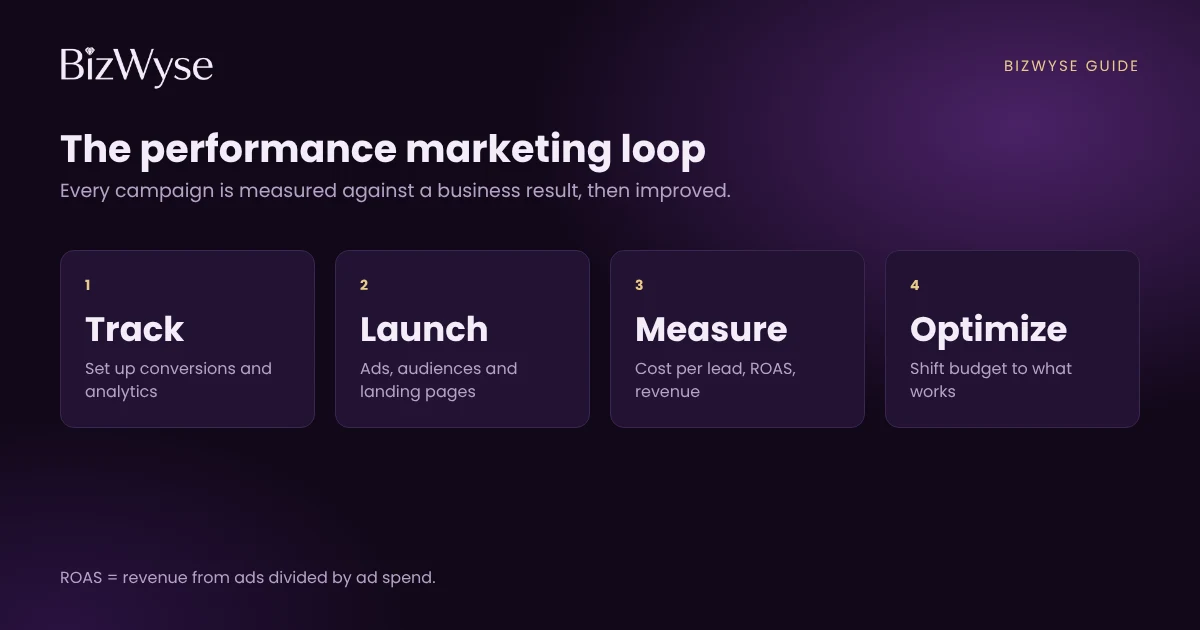
- Track: install analytics and conversion tracking before spending anything. Without it, you cannot judge results.
- Launch: build ads, audiences and landing pages around one clear offer.
- Measure: look at cost per lead, conversion rate and return on ad spend (ROAS).
- Optimize: pause weak ads, test new ones and move budget to the winners.
Understanding ROAS
ROAS means return on ad spend: the revenue an ad campaign produces divided by what you spent on it. If you spend 1,000 and the ads bring 3,600 in sales, ROAS is 3.6. A higher number is better, but it is only useful when you also know your margins. A product with thin margins needs a higher ROAS to stay profitable.
For lead-generation businesses, cost per qualified lead is often more useful than ROAS. Ask your agency to report both, and to explain how a lead becomes a customer.
When you need a performance marketing agency
- You already have a product or service that people buy, and want more customers.
- You can track sales or leads, even in a simple spreadsheet.
- You have a landing page or website that converts reasonably well.
- You can commit a test budget for at least a few weeks.
If your website is slow or confusing, fix it first. Ads send traffic, but they cannot repair a poor page. That is why our performance marketing agency work starts with tracking and landing pages, not only ads.
What to ask a performance marketing agency
- How will you measure success, and who owns the ad accounts?
- What is the minimum budget and testing period you recommend?
- How often will I get reports, and what is in them?
- Do you also improve landing pages and conversion rates?
- How do you handle fees: a flat fee, a percentage of spend, or both?
Always keep ownership of your ad accounts and data. If an agency runs ads from its own account and refuses access, you could lose history when you leave.
Common mistakes
- Spending before conversion tracking works
- Changing too many things at once, so you cannot tell what helped
- Judging results after only a few days
- Sending all traffic to the home page instead of a focused landing page
- Chasing clicks instead of customers
Choosing the right ad channels
Each channel serves a different stage of the customer journey. Search ads on Google are strong when people already look for what you sell, so they usually bring high-intent leads. Social ads on Meta platforms are better for building awareness and reaching people before they search, and they work well for visual products. LinkedIn suits business-to-business offers, though clicks often cost more.
Retargeting is worth adding early. It shows ads to people who visited your site but did not convert, and it often produces some of the lowest-cost conversions because those visitors already know you. A sensible plan starts with one or two channels, proves that they work, then expands.
Landing pages and conversion rate
Ad clicks cost money, so what happens after the click matters as much as the ad. A good landing page matches the promise in the ad, loads fast, shows the main benefit above the fold, and offers one clear action. Remove distractions such as long menus. Add proof: short testimonials, results, logos or guarantees you can honestly back up.
Small conversion gains compound. If a page converts at 3 percent instead of 2 percent, the same traffic brings 50 percent more leads, and your cost per lead falls without raising the ad budget.
Testing the right way
Performance marketing relies on structured testing. Change one element at a time, such as the headline, image, audience or offer, and give each test enough time and traffic to show a clear difference. Keep a simple log of what you tested and what you learned. This prevents repeating failed ideas and helps new team members understand why a campaign is set up the way it is.
How agencies are paid
Fee models vary. Some agencies charge a flat monthly fee, some charge a percentage of ad spend, and some combine the two. A percentage-only model can encourage higher spending, so check that goals are tied to results and not only to budget. Whatever the model, ask for a written scope that explains what is included, such as ad creation, landing pages, tracking and reporting.
Frequently asked questions
How is performance marketing different from digital marketing?
Digital marketing is the broad field. Performance marketing is the part where spend is tied to measurable outcomes and optimized against them.
How much budget do I need?
Enough to collect meaningful data. A very small budget can still work if the target is narrow, but expect a testing period before costs settle.
How long until I see results?
Paid ads can bring visits within days, but stable, profitable performance usually takes a few weeks of testing and optimization.
Next step
Write down your offer, your target customer and what one new customer is worth to you. With those three answers, any agency can build a sensible test plan.
If you want a second opinion on your current website or marketing, request a free technical audit from Bizwyse. We review speed, SEO and conversion gaps and send back a plain-language report, with no obligation.
Keep reading
Digital Marketing in the UAE: Working With a Remote Agency
How UAE businesses can work with a remote digital marketing agency: channels, language, reporting and the questions to ask before you start.
Oct 15, 2026 · 5 min read
Website Developers vs. a Web Development Agency: Which Should You Hire?
Freelance website developers or a web development agency? Compare cost, skills, risk and support, and learn how to compare quotes fairly.
Oct 15, 2026 · 5 min read
Digital Marketing Agency in Dhaka: Services, Channels and How to Choose
What a digital marketing agency in Dhaka does, which channels fit which goals, and the checks that help you pick the right partner.
Oct 15, 2026 · 5 min read