
How to Choose a Web Development Company in Bangladesh: A 2026 Buyer's Guide
A good web development company in Bangladesh builds a fast, secure and search-friendly website, explains its work in plain language, and stays available after launch. This guide gives you seven checks to run before you sign, plus the questions that separate a reliable partner from a risky one. It applies whether you need a company site, an online store or a custom web application.
Why the choice matters more than the price
Your website is often the first thing a customer, investor or partner sees. A slow, broken or confusing site costs you enquiries every day, and fixing a poor build later usually costs more than doing it properly the first time.
The cheapest quote is rarely the cheapest outcome. Template reskins, bloated plugins and missing security basics are common in low-cost builds, and they show up months later as slow pages, hacked sites and traffic that never arrives. Judge a web development company by what it delivers over two or three years, not by the number on the first proposal.
1. Ask to see real, recent work
Start with the portfolio, but go deeper than screenshots. Open the live sites on your phone and ask three questions:
- Does the site load quickly on a mobile connection?
- Is it easy to find the main action, such as calling, booking or buying?
- Do the pages have clear headings, readable text and working forms?
Ask which parts of each project the company built itself. Some agencies resell work done by others, which is fine if they say so, but you should know who will actually maintain your site. If the team can share a short case study with a measurable result, such as faster load time or more organic traffic, that is a strong sign.
2. Check speed and Core Web Vitals
Speed is not a luxury. Google measures real-user experience with Core Web Vitals, and these metrics feed into search performance. Ask any company you are considering what scores their recent projects achieve, and ask how they test before launch.
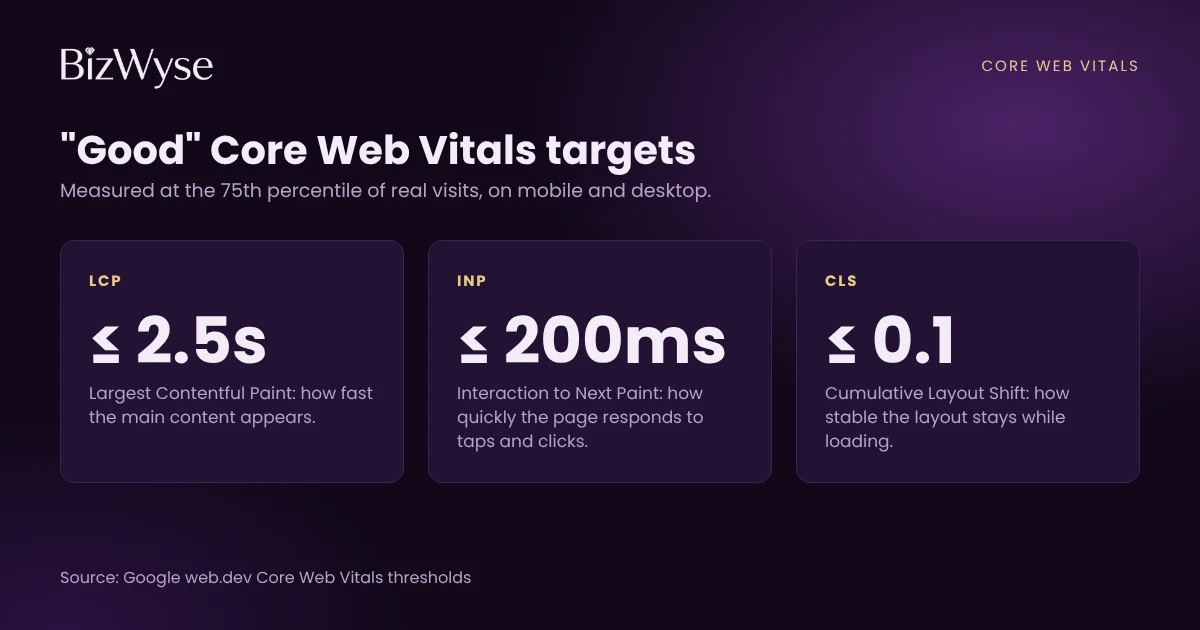
A capable team will talk about image optimization, clean code, caching and hosting choices without hiding behind jargon. They should also be willing to test your current site and show you where it loses time. If a company cannot explain how it keeps pages fast, expect a slow site.
3. Make sure SEO is part of the build
Many businesses launch a beautiful site and then discover it cannot be found. Search engine optimization works best when it is planned from the start, not bolted on afterwards. Ask whether the price includes:
- A logical page structure and clean URLs
- Unique title tags and meta descriptions for every page
- Structured data (schema markup) for your business and services
- An XML sitemap and a robots.txt file
- Image compression and descriptive alt text
- Mobile-first layouts
If you want ongoing visibility, look for a team that also offers SEO services in Bangladesh or international SEO, so the site and the traffic plan are designed together instead of by two teams who never talk.
4. Understand the technology, in plain language
You do not need to become a developer, but you should know what your site is built on and who owns it. Ask these questions:
- Which platform or framework will you use, and why is it right for my goals?
- Will I be able to edit content myself without calling you?
- Who owns the code, the design files and the hosting account?
- Is the architecture documented so another developer could take over?
The answers tell you about the company's honesty. A good partner recommends a technology that fits your needs, such as WordPress for content-heavy sites or a modern framework for performance-critical applications, and explains the trade-offs. A weak partner pushes whatever they already know.
5. Look for a clear process and milestones
Most website projects fail because of unclear scope, not because of bad code. Ask to see the process before you sign. A typical project moves through discovery, design, development, testing and launch, and a standard business website usually takes four to eight weeks depending on size and how fast approvals come back.
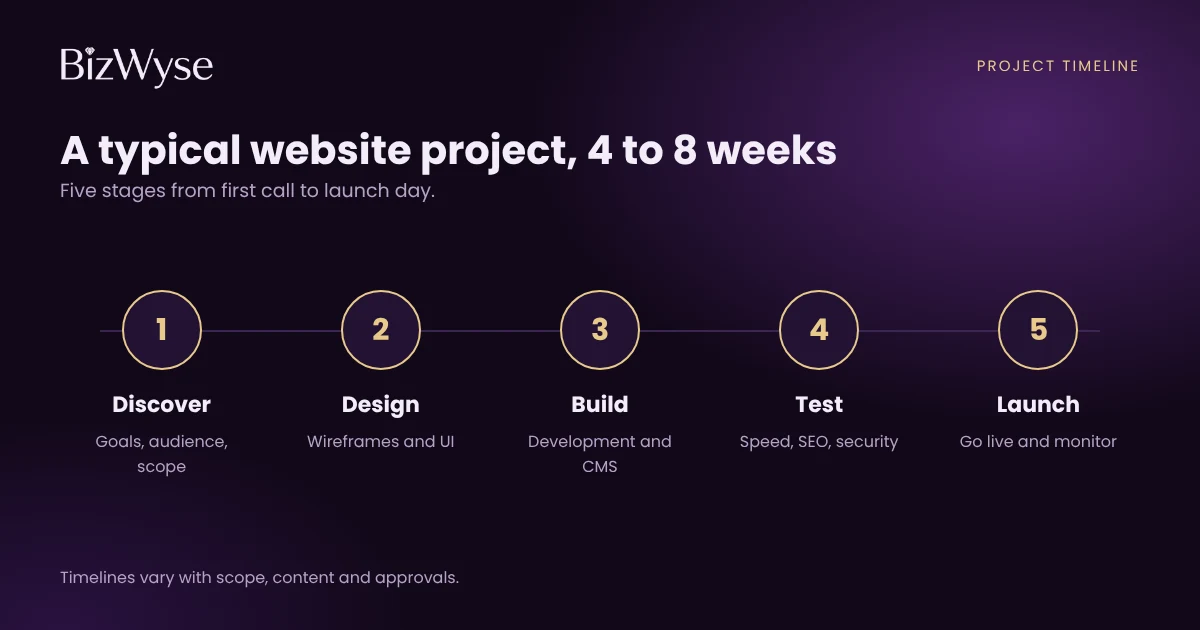
Insist on written milestones, a defined number of revision rounds, and a named point of contact. Regular updates, even short ones, keep a project honest and let you catch problems early.
6. Check security and ongoing support
Launch day is the beginning, not the end. Sites need updates, backups and monitoring. Ask what happens if the site goes down at night, how quickly the team responds to bugs, and whether maintenance is included or sold separately.
At a minimum, expect HTTPS everywhere, regular backups, protected admin logins, and a plan for updates. If a company is vague about support, assume you will be on your own when something breaks.
7. Compare proposals fairly
Collect two or three quotes and compare them line by line, not only by total cost. Write down what each one includes: number of pages, design rounds, SEO setup, content entry, training, hosting, maintenance and post-launch support. A proposal that looks cheaper often leaves out items another one lists clearly.
Pay attention to how each company communicates. Replies that are prompt, specific and free of buzzwords usually predict how the project will go. Be careful with anyone who promises first-page rankings or guarantees a traffic number, because no honest team can control Google.
Red flags to walk away from
- No live examples, or examples they cannot explain
- No written scope, timeline or payment schedule
- Refusal to hand over code, files or admin access at the end
- Guaranteed rankings or instant results
- No mention of security, backups or testing
Frequently asked questions
How long does it take to build a website in Bangladesh?
A standard business website takes about four to eight weeks. Larger web applications and e-commerce stores take longer because of custom features and integrations.
Should I choose a local or an international agency?
Choose on skill, communication and track record rather than location. A Dhaka-based web development company can serve Bangladeshi and overseas clients remotely if it works in your time zone and keeps you updated.
Will my site rank on Google after launch?
A well-built site gives you a strong technical foundation, but rankings also depend on content, links and competition. Plan for three to six months of steady work before you judge SEO results.
Next step
Use the seven checks above to shortlist two or three companies, then ask each one the same questions. If you want a second opinion on your current website, request a free technical audit from Bizwyse. We review speed, SEO and conversion gaps and send back a plain-language report, with no obligation.
Keep reading
Digital Marketing in the UAE: Working With a Remote Agency
How UAE businesses can work with a remote digital marketing agency: channels, language, reporting and the questions to ask before you start.
Oct 15, 2026 · 5 min read
Website Developers vs. a Web Development Agency: Which Should You Hire?
Freelance website developers or a web development agency? Compare cost, skills, risk and support, and learn how to compare quotes fairly.
Oct 15, 2026 · 5 min read
Digital Marketing Agency in Dhaka: Services, Channels and How to Choose
What a digital marketing agency in Dhaka does, which channels fit which goals, and the checks that help you pick the right partner.
Oct 15, 2026 · 5 min read